
May 12th 2026
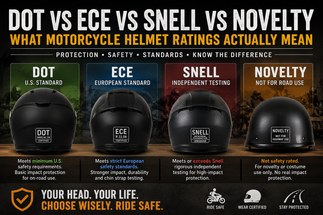
D.O.T. vs. ECE vs. Snell vs. Novelty: What Motorcycle Helmet Ratings Actually Mean
For motorcycle riders, a helmet is the most crucial piece of safety gear you’ll ever own. But when you’re browsing for a new lid, the back of the helmet is usually covered in acronyms and stickers: D.O.T., ECE, Snell, and sometimes nothing at all.
What do these labels actually mean for your safety, your wallet, and your legal right to ride?
Whether you prefer a low-profile half helmet, a classic open-face, or a full-face racing shield, understanding these ratings ensures you stay legal on the road and protected in a crash. Here is the ultimate breakdown of motorcycle helmet safety standards.
1. D.O.T. Certified Helmets: The Standard for American Roads
The D.O.T. sticker means the helmet meets Federal Motor Vehicle Safety Standard (FMVSS) No. 218, set by the United States Department of Transportation.
If you are riding in a state with a helmet law (like New Jersey), your helmet must be D.O.T. certified to be legal on public roads.
How D.O.T. Helmets are Tested:
-
Impact Attenuation: The helmet is dropped onto an anvil to measure how well it absorbs energy.
-
Penetration Resistance: A sharp striker is dropped onto the helmet shell to ensure objects won't pierce through to your skull.
-
Retention System: The chin strap is subjected to heavy loads to ensure it won’t snap or stretch out during an accident.
Note on D.O.T. Testing: The D.O.T. system relies on a "self-certification" model. Manufacturers test their own helmets to ensure compliance before putting them on the market, and the government randomly tests samples later. To ensure you are getting a genuine lid, look for premium, reputable brands like Daytona Helmets, which specialize in designing D.O.T.-approved styles that offer safety while keeping a sleek, low-profile look.
2. ECE Certified Helmets: The Global Gold Standard
The ECE rating stands for the Economic Commission for Europe (specifically regulation ECE 22.05 or the newer 22.06). It is the recognized standard in over 50 countries and is widely respected by racing organizations worldwide, including MotoGP.
Unlike the D.O.T. system, ECE requires independent batch testing before a helmet can ever be sold to the public.
Why the ECE Standard is Highly Respected:
-
Real-World Impact Angles: ECE tests include oblique impact testing, measuring how well a helmet handles rotational forces (which cause brain shear injuries during sliding crashes).
-
Component Testing: They test the durability of the visor, the friction resistance of the outer shell, and even how the chin strap responds to abrasion.
-
Strict Quality Control: Samples are continually pulled from production lines to verify that factory models match the exact specs of the prototype that passed the initial test.
3. Snell Certified Helmets: Premium Race-Grade Protection
The Snell Memorial Foundation is an independent, non-profit organization in the United States established in memory of racer Pete Snell. Unlike D.O.T. and ECE, Snell certification is completely voluntary. Manufacturers choose to send their helmets to Snell to prove they meet the highest possible safety standards, often for track or racing use (look for the M2020 or M2025 ratings).
What Makes Snell Testing Unique?
-
Aggressive Multi-Impact Testing: Snell drops helmets multiple times on the exact same spot to ensure the shell and liner can handle secondary impacts (like bouncing on the pavement or hitting a guardrail).
-
Extreme Penetration and Chin Bar Tests: They use a heavier firing pin for penetration tests and rigorously test the structural integrity of full-face chin bars.
-
Stricter Standards: Because Snell standards are so incredibly demanding, they are generally found on high-end, premium full-face and modular helmets rather than half helmets.
4. Novelty Helmets: What You Need to Know
You’ve probably seen them on the road: ultra-thin, incredibly lightweight beanies that look sharp but offer minimal bulk. These are commonly referred to as novelty helmets.
It is vital to understand that novelty helmets are not safety devices. They do not carry a D.O.T., ECE, or Snell certification, and manufacturers explicitly sell them as non-protective items.
The Risks of Riding in a Novelty Helmet:
-
No Impact Protection: Novelty helmets typically feature a thin fiberglass or plastic shell lined with fabric or a sliver of regular foam, rather than the thick, energy-absorbing Expanded Polystyrene (EPS) safety foam found in certified helmets.
-
Legal and Ticket Risks: In states with mandatory helmet laws, wearing a novelty helmet on public roads can result in law enforcement pulling you over and issuing a ticket for riding without a legal helmet.
-
Retention Failure: The chin straps and buckles on novelty lids are rarely tested for high-velocity impacts, meaning the helmet is highly likely to fly off your head the moment you hit the asphalt.
If you love the minimal, lightweight look of a beanie but want actual protection and legal peace of mind, the best move is to look for a low-profile D.O.T. half helmet. High-quality manufacturers have mastered the engineering required to eliminate the "mushroom head" look while keeping the internal safety liner thick enough to protect you.
Helmet Ratings: Quick Comparison
| Feature | D.O.T. Certified | ECE Certified | Snell Certified | Novelty Helmets |
| Street Legal (NJ & Law States) | Yes | Yes (If also D.O.T. marked) | Yes (If also D.O.T. marked) | No |
| Testing Protocol | Self-certified / Random audits | Independent lab mandatory | Voluntary / Independent lab | None |
| Multi-Impact Testing | No | No | Yes | No |
| EPS Safety Liner | Yes | Yes (Advanced multi-density) | Yes (Premium race-grade) | No (Fabric or thin foam) |
Final Thoughts: Protect Your Ride
When you're out on the open road, your gear is the only thing standing between you and the pavement. While novelty helmets offer a certain aesthetic for bike shows or private property, a certified helmet is non-negotiable for real-world street riding.
Whether you opt for the standard reliability of a D.O.T. lid, the global engineering of an ECE helmet, or the extreme protection of a Snell badge, investing in proper gear ensures you stay legal, comfortable, and—most importantly—make it home after every ride.