
Jul 13th 2026
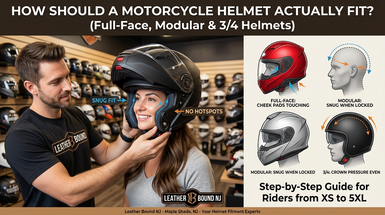
How Should a Motorcycle Helmet Actually Fit? (Full-Face, Modular & 3/4 Helmets)
Buying a motorcycle helmet is one of the most critical gear decisions you’ll make. But whether you’re looking at a full-face, modular, or classic 3/4 helmet, one rule stands above all others: a helmet that doesn’t fit correctly cannot protect you correctly.
A loose helmet can shift or pull off entirely during an impact, while a helmet that’s too tight will cause severe pressure headaches within 20 minutes of riding.
If you’ve ever wondered if your helmet is too tight, too loose, or just right, here is the exact step-by-step guide to finding your perfect fit across full-face, modular, and 3/4 open-face helmets.
1. Understanding Head Shapes (Before You Measure)
Two people can have the exact same head circumference and still wear completely different helmet sizes. Why? Head shape.
Helmet manufacturers design interior EPS foam liners for three primary head shapes:
-
Long Oval: Head length (front to back) is noticeably longer than width (ear to ear).
-
Intermediate Oval: The most common shape in North America. Slightly longer front-to-back than side-to-side.
-
Round Oval: Head length and width are nearly equal.
The Red Flag: If a helmet presses hard against your forehead but leaves space on the sides, the helmet is too round for your head. If it grips the sides of your head but wobbles front-to-back, it’s too oval.
2. The Step-by-Step Helmet Fitment Tests
When trying on a new helmet, do not judge the fit the second your head goes in. Follow these three quick tests to verify true fitment:
Test A: The "Cheek Pinch" Test
When you strap on a full-face, modular, or 3/4 helmet, your cheek pads should push your cheeks up slightly toward your eyes, similar to a light "chipmunk cheek" look.
-
Pass: You can chew gum or talk, but you might bite the inside of your cheeks slightly if you talk fast.
-
Fail: If your jaws move freely without touching the padding, the helmet is too big.
Test B: The Roll & Roll Test (The Grab Test)
Fasten the chin strap securely (you should be able to fit two fingers between the strap and your neck). Hold the chin bar or the sides of the helmet with both hands and gently try to rotate the helmet left to right, then tilt it forward and back.
-
Pass: Your skin and scalp should move with the helmet lining.
-
Fail: If the helmet slides across your skin or rotates around your head without pulling your scalp, drop down a size.
Test C: The 15-Minute Pressure Point Test
Wear the helmet around the house or in-store for 15 to 20 minutes.
-
Pass: Even pressure around the entire crown of your head without sharp pain points.
-
Fail: A deep red line or localized throb on your forehead or temples means you have a hot spot. You need a different head shape, not necessarily a larger size.
3. Fitment Nuances: Full-Face vs. Modular vs. 3/4 Helmets
While the overall crown fit remains identical, each helmet style has specific fit dynamics to keep in mind:
+------------------+-----------------------------------------------------------+
| Helmet Type      | Key Fitment Consideration                                 |
+------------------+-----------------------------------------------------------+
| Full-Face        | Highest overall snugness; jaw & cheek pads do heavy lifting|
| Modular (Flip)   | Always test fit with the chin bar CLOSED & LOCKED         |
| 3/4 (Open Face)  | Requires tight crown fit to prevent wind lifting at speed |
+------------------+-----------------------------------------------------------+
Full-Face Helmets
Full-face helmets offer maximum protection and surround your head completely.
-
Key Focus: Cheek pads and jawline contact. Cheek pads will break in roughly 15% to 20% over the first 10–12 hours of riding. If a full-face helmet feels "comfortably loose" in the store, it will be dangerously oversized once broken in.
Modular (Flip-Up) Helmets
Modular helmets offer the versatility of an open-face at stops and full coverage while riding.
-
Key Focus: Test with the chin bar down! Closing and locking the chin bar pulls the sides of the helmet inward. Always judge the tightness of a modular helmet with the chin bar fully locked in place.
3/4 (Open-Face) Helmets
Because 3/4 helmets lack a chin bar, highway wind can catch under the peak or shield and push the helmet backward (known as "buffeting" or helmet lift).
-
Key Focus: The crown and temple fit must be ultra-secure. If the top of the helmet doesn't hug your head snugly, wind at 65 mph will pull the helmet up and push the chin strap against your throat.
Why Online Sizing Guesses Fail (And Why In-Person Matters)
Size charts are a great starting point, but they only measure circumference, they cannot measure head shape, jawline structure, or cheek fullness.
Choosing a helmet online often leads to returning two or three boxes before finding one that doesn't cause forehead pain. Trying helmets on in person allows you to compare different shell shapes side-by-side, test cheek pad thicknesses, and get immediate feedback before you buy.
Stop by Leather Bound NJ for an Expert Helmet Fitting
Finding the right fit doesn't have to be a guessing game. At Leather Bound NJ, we stock a full selection of DOT-approved full-face, modular, and 3/4 helmets across all head shapes and sizes from XS up to 5XL.
-
Expert Staff: Our team will help you identify your true head shape, check cheek pad pressure, and eliminate pressure points before you hit the road.
-
Massive In-Stock Selection: Compare multiple styles, colors, and shell shapes side-by-side on the rack.
-
Convenient Location: Located at 48 Route 73 N in Maple Shade, NJ, just minutes off I-295, the NJ Turnpike, and the Philly bridges.
Browse Our Full Helmet Collection Online or stop into the showroom today to get properly fitted for your next helmet!