
Jun 1st 2026
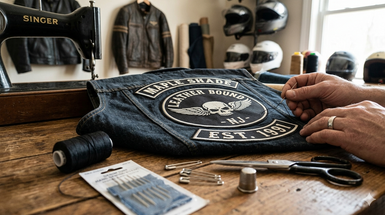
The Rider’s Guide: How to Sew Patches onto a Denim Vest
Whether you are adding a single memorial patch or a full three-piece club set, the way you attach them determines how long they—and your vest—will last. Because our
1. Prep the Canvas
Before the first stitch, you must "set" the vest.
-
Wash and Dry: If your vest is 100% cotton denim, wash and dry it once. This pre-shrinks the material so your patches won't pucker later.
-
The Flat Test: Lay the vest on a hard, flat table. Do not try to pin patches while the vest is on a hanger or a person.
2. Positioning & Symmetry
For a single-piece back panel, centering is everything.
-
The Fold Method: Fold the vest in half vertically and lightly crease the center with an iron. This gives you a perfect "dead center" line.
-
Rule of Thumbs: For the top rocker, measure two to three fingers down from the collar seam. This ensures the patch doesn't "climb" onto your shoulders when you're in a riding position.
3. The Right Tools for 14oz Denim
Standard thread will snap under high-speed wind resistance. You need:
-
Thread: Use Heavy Duty Nylon or Polyester thread. It is UV resistant and won't rot from rain or sweat.
-
Needle: Use a Denim Needle (Size 100/16 or 110/18). If sewing by hand, use a "Thimble" or a pair of pliers to help pull the needle through the thick seams.
4. Avoiding the "Lining Trap"
This is the most common mistake. Many Leather Bound vests feature a concealed carry liner. If you sew through the denim AND the liner, you will sew your CCW pockets shut.
-
The Separation: Open the access zipper (usually located at the bottom or side of the vest) that allows you to get between the denim shell and the interior lining.
-
Pinning: Only pin the patch to the outer denim layer. Reach inside to ensure your pins haven't snagged the mesh or textile liner.
5. The Stitching Technique
-
The "Whip Stitch" vs. "Straight Stitch": A straight stitch is cleaner, but a tight whip stitch (going over the edge of the patch) provides the best security against "wind-flap."
-
Hidden Knots: Always start and end your thread on the inside of the denim shell so the knots are hidden by the liner once you've zipped it back up.
Pro Tip: If you aren't confident with a machine, most local upholstery shops or dry cleaners in the Maple Shade and Philadelphia area have heavy-duty machines that can handle 14oz denim easily. Just remember to tell them: "Don't sew through the liner!"
Ready to start your project?
If you haven't picked up your "canvas" yet, browse our